

- Medical News
Why Indian Hospitals Fall Behind in Medical Research: A Look at the Incentive Crisis

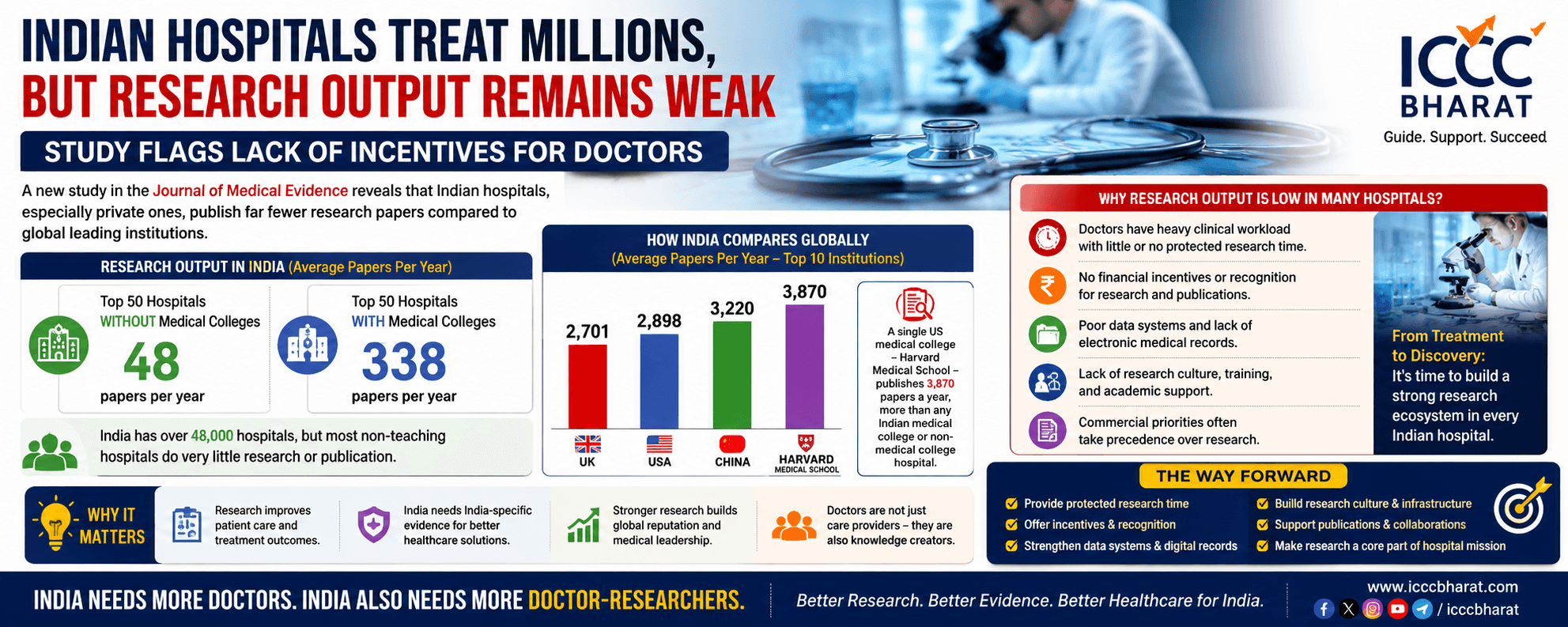
A newly published study has exposed a stark reality in India’s healthcare landscape: despite boasting a massive network of medical institutions, the country’s hospitals are producing remarkably low scientific research output compared to their global peers.
The research paper, published on June 15 in the Journal of Medical Evidence, highlights that a lack of academic teaching systems and proper incentives are keeping Indian doctors from publishing scientific literature.
The Massive Divide: Medical Colleges vs. Standalone Hospitals
The study reveals a profound gap between institutions tied to medical universities and those that operate strictly as healthcare facilities:
- The Non-College Slump: India’s top 50 standalone, non-medical college hospitals produce a meager average of just 48 research papers per year.
- The University Advantage: In contrast, the top 50 hospitals attached to medical colleges (led by AIIMS Delhi) fare better, averaging 338 papers annually.
- The Top Tier Elite: When narrowing the lens to the top 10 institutions in each category, the gap widens significantly. While top hospitals without colleges manage 133 papers a year, the top 10 medical colleges produce seven times more research, averaging 740 papers annually.
Note: Sir Ganga Ram Hospital in New Delhi leads the non-college sector, topping its respective list with an average of 253 papers per year.
Global Comparisons: The Staggering Scale of India’s Deficit
Even India’s most productive medical colleges pale in comparison to Western and Asian counterpart institutions. According to data collected between 2021 and 2025 across databases like PubMed, Scopus, and Google Scholar, the international benchmarks are on another level:
- United Kingdom: The top 10 institutions average 2,701 papers annually.
- United States: The top 10 elite facilities hit an average of 2,898 papers per year.
- China: Leads the global pack with the highest institutional average of 3,220 papers annually.
To put this deficit into perspective, the study notes that a single American institution—Harvard Medical School—generates an average of 3,870 papers a year, outproducing any individual medical or non-medical college hospital in India. Furthermore, the Mayo Clinic’s annual output of 8,000 papers eclipses the research volume of the entire Indian private healthcare sector combined.
Structural Barriers to Medical Innovation
The root of the issue is largely structural. India currently tracks approximately 49,000 medical institutions. Out of these, a mere 800 are attached to medical colleges.
The vast majority—over 48,000 facilities, consisting heavily of major private networks like Apollo Hospitals, Medanta Medicity, and even Sir Ganga Ram Hospital—function strictly as commercial healthcare delivery centers. Because they are disconnected from teaching systems, clinicians face a lack of incentives, time, and infrastructure required to prioritize academic publishing alongside patient care.
About the Authors
The paper was co-authored by prominent surgeons Dr. Samiran Nundy and Dr. Parmanand Tiwari, both affiliated with Sir Ganga Ram Hospital in New Delhi.
Dr. Nundy, a renowned gastrointestinal surgeon and 1985 Padma Shri recipient, also serves as the President of AIIMS Rishikesh. He is well-known in the medical publishing community as the founding editor of both the National Medical Journal of India and Tropical Gastroenterology.