
- Health Policy
- Medical News
- Mohfw News
- NBE News
Systemic Paralysis: The NEET-SS 2025 Counselling Delay is an Administrative Failure Holding India’s Healthcare Hostage

The catastrophic and indefinite delay in the NEET-SS 2025 Round-2 counselling is no longer just a bureaucratic hiccup—it is a glaring manifestation of administrative incompetence, structural paralysis, and a blatant disregard for the careers of India’s highly trained medical professionals. Candidates who have conquered one of the most brutal competitive examinations in the world are currently left stranded in a state of forced unemployment and severe psychological distress. This crisis is not born out of any academic shortcoming on the part of the aspirants, but rather from a total lack of coordinated decision-making, systemic accountability, and foresight among the governing authorities.
According to the official Medical Counselling Committee (MCC) notice dated April 24, 2026, the choice filling for Round-2 of NEET-SS Counselling 2025 has been frozen “until further orders” due to ongoing litigation in Tamilvani & Ors. vs State of Tamil Nadu (W.P. No. 415 of 2026) before the Hon’ble Supreme Court concerning the reversion of in-service seats to the All India Quota pool. While judicial processes must be implicitly respected, using an active court case as a shield to completely paralyze a national admission engine is administratively unacceptable. By freezing the entire mechanism, the MCC and Ministry of Health have effectively held thousands of super-speciality aspirants hostage, disrupting their academic timelines, employment opportunities, senior residencies, and financial stabilities.
Exploiting Student Discipline While Rewarding Bureaucratic Inertia
The sheer hypocrisy of the medical admission ecosystem is staggering. Aspirants are bound to a draconian set of rules: they must register on time, upload documents on time, pay exorbitant fees on time, and report to colleges on time, or face immediate disqualification and heavy financial penalties. Yet, when the system itself defaults—revising schedules, extending timelines indefinitely, and leaving websites dormant with generic “check back later” notices—there is absolute impunity.
The Federation of All India Medical Association (FAIMA) has vehemently blasted this delay, pointing out that it has forced top-tier medical minds into arbitrary unemployment and immense financial hardship. Who is accountable for the structural decay that turns a premier national counselling process into an annual chaotic lottery? The constant flip-flops regarding seat matrices, NRI quota regulations, and state coordination demonstrate that the current central counselling structure is structurally broken and operates without a safety net.
Fragmented Accountability: The Multi-Agency Blame Game
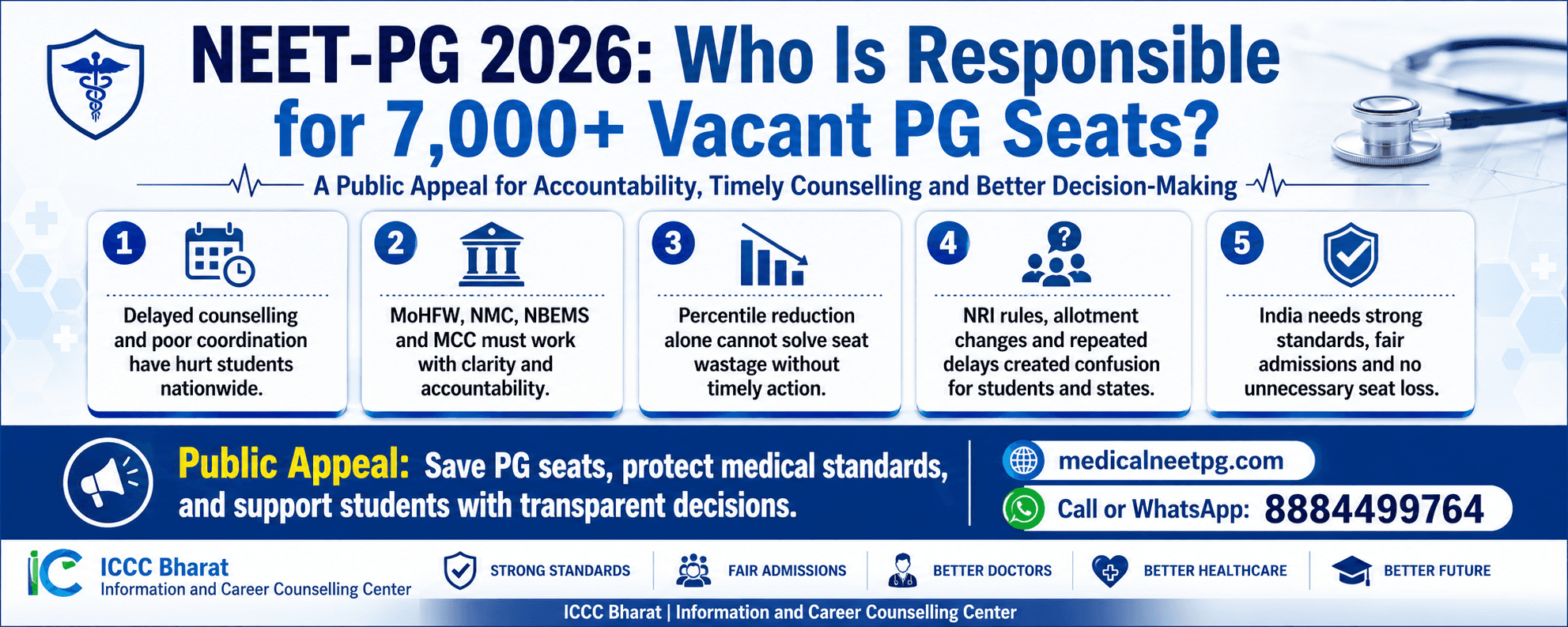
The ongoing gridlock exposes a severe lack of coordination among the vital pillars of India’s medical education framework:
- The Ministry of Health and Family Welfare (MoHFW)
- The National Medical Commission (NMC)
- The Directorate General of Health Services (DGHS) / MCC
- The National Board of Examinations in Medical Sciences (NBEMS)
When a crisis erupts, responsibility vanishes. Students are pushed into a multi-agency blame game where one entity points to legal constraints, another to technical dependencies, and a third to ministerial policy. This fragmented approach is unacceptable for a nuclear-armed nation aiming for global healthcare dominance. The Government of India must recognize that even if technical execution is outsourced or distributed across agencies, the ultimate constitutional and moral accountability stops squarely with the central government.
A Direct Assault on Public Healthcare
This delay is not merely an educational grievance; it is a direct blow to the Indian public healthcare system. The candidates trapped in this administrative limbo are not entry-level students; they are future cardiologists, neurologists, oncologists, nephrologists, and urologists—the rarest and most critically needed commodities in India’s medical infrastructure.
As FAIMA has rightly warned, freezing the induction of super-specialists is actively causing severe workforce shortages across super-speciality departments nationwide. Hospitals are facing extreme manpower deficits, existing senior residents are buckling under inhumane workloads, and critical care patients are paying the ultimate price for bureaucratic gridlock. This administrative failure is directly compromising the quality of specialized healthcare delivery in India.
The Hard Line: Demands for Immediate Executive Intervention
Respecting the judiciary does not mean slipping into absolute administrative inertia. The government and the MCC possess the legal and executive machinery to mitigate student suffering, yet they choose absolute paralysis.
We forcefully appeal to the Prime Minister’s Office (PMO) and the MoHFW to bypass bureaucratic red tape and implement the following directives immediately:
- Segregate the Litigation: File an urgent mentioning before the Hon’ble Supreme Court to isolate the disputed seats and immediately resume Round-2 counselling for all unaffected super-speciality seats nationwide.
- Issue an Uncompromising Timeline: Stop hiding behind generic notices. Publish an immediate, transparent, and legally binding roadmap for the completion of Round-2.
- Establish a Dedicated Grievance Portal: Create a direct, single-window response mechanism specifically for affected NEET-SS aspirants to address financial and career disruptions.
- Enact Structural Counselling Reform: Dissolve this fragmented, ad-hoc committee culture and establish a singular, autonomous, and professionally audited National Medical Counselling Authority with direct accountability to Parliament.
Conclusion
The NEET-SS 2025 counselling fiasco has exposed deep structural flaws within India’s medical admission framework. Academic time is being wasted, hospitals are being starved of specialists, and the country’s finest doctors are being penalized for a crisis they did not create.
The Ministry of Health cannot remain a silent spectator while the careers of our finest physicians erode in a vacuum of leadership. This system requires an urgent, radical overhaul. Our doctors have given years of their lives to serve this nation; they must not be sacrificed on the altar of administrative apathy. The government must act now, or accept full responsibility for the decay of India’s super-speciality healthcare pipeline.